GEOTECHNICAL ENGINEERING
OKLAHOMA CITY
HomeLaboratoryLaboratory CBR test

Laboratory CBR Testing for Pavement Design in Oklahoma City

Evidence-based design. Reliable delivery.

LEARN MORE

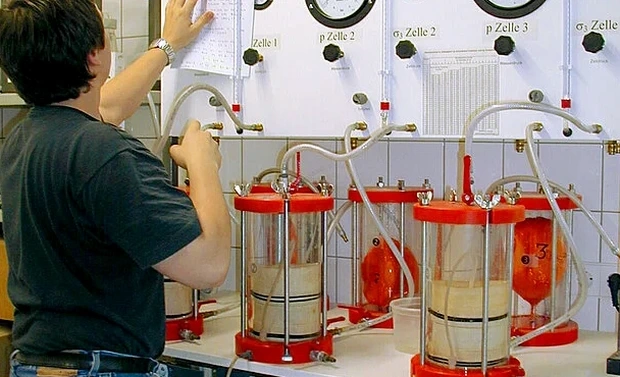
ASTM D1883 sets the standard for California Bearing Ratio testing, and in Oklahoma City it applies directly to the expansive clays that dominate our subsurface. The CBR value dictates pavement thickness, subgrade treatment, and ultimately how long a road or parking lot survives our freeze-thaw cycles and summer droughts. We run the laboratory CBR test on remolded specimens compacted to project density, measuring penetration resistance at controlled moisture. For projects along the I-35 corridor or new industrial pads near Will Rogers World Airport, the lab CBR pairs naturally with field compaction verification via sand cone density to ensure the placed fill matches the design curve. Oklahoma City sits on the Garber-Wellington aquifer recharge zone, so subgrade moisture sensitivity is not theoretical here — it shows up in rutting and edge cracking within two seasons if the CBR assumptions are wrong. We report soaked and unsoaked CBR values, plus swelling percentage, which matters on these high-plasticity soils.

A soaked CBR under 3 on Oklahoma City clay means the subgrade needs stabilization — no pavement design survives without that call.
Our service areas

Process and scope

The reddish-brown clay common across Oklahoma County is classified as CL to CH under the Unified Soil Classification System, with liquid limits frequently above 45. That means standard Proctor compaction leaves it vulnerable to moisture intrusion, and the laboratory CBR test becomes a direct performance indicator. We compact specimens at optimum moisture, soak them for 96 hours per ODOT specification, and measure load-penetration. A soaked CBR below 3 signals mandatory subgrade stabilization — lime treatment or geogrid reinforcement. The test also feeds empirical pavement design equations from the 1993 AASHTO Guide, still the backbone of most municipal specs in the metro. For deeper stratigraphy questions, a test pit excavation lets us recover undisturbed block samples, and when the subgrade profile is erratic we add grain size analysis to pin down fines content across the alignment. The lab CBR alone gives a number; combined with index testing it tells a full story.
Laboratory CBR Testing for Pavement Design in Oklahoma City
Technical reference — Oklahoma City

Local geotechnical context

A warehouse expansion off SW 29th Street went to bid with a design CBR of 8 based on old county soil surveys. We ran soaked CBR on Shelby tube samples from four borings: actual values ranged from 2.1 to 3.4. That gap meant the pavement section was under-designed by almost two inches of asphalt — caught during submittal review, but just barely. The most common failure mode in Oklahoma City is differential swelling under rigid pavement, where one slab edge sits on drier native clay and the adjacent slab spans a wetter utility trench backfill. The soaked CBR captures that worst-case scenario in a lab environment, giving the design engineer a lower-bound strength to work with. Skipping the lab CBR test pushes all the risk onto the contractor and the owner, and the warranty claims start showing up at year three.

Need a geotechnical assessment?

Reply within 24h.

Email: contact@geotechnical-engineering.xyz

Applicable standards

ASTM D1883 — Standard Test Method for California Bearing Ratio (CBR) of Laboratory-Compacted Soils, ODOT Standard Specifications for Highway Construction, Section 303 — Aggregate Base Courses, AASHTO Guide for Design of Pavement Structures (1993, with Oklahoma supplements), IBC 2021 Section 1803 — Geotechnical Investigations

Technical parameters

ParameterTypical value
Standard followedASTM D1883 (soaked and unsoaked)
Specimen compaction methodStandard or modified Proctor (ASTM D698 / D1557)
Soaking period96 hours (ODOT typical); shorter by request
Penetration rate0.05 in/min (1.27 mm/min)
Surcharge weight10 lb annular (simulates base course)
Reported valuesCBR at 0.1" and 0.2" penetration, swell %
Turnaround3-5 business days standard

Common questions

What does the laboratory CBR test cost in Oklahoma City?

Standard soaked CBR per ASTM D1883 runs between US$110 and US$200 per specimen, depending on whether Proctor compaction data already exists and the number of points on the curve. A typical pavement investigation with three CBR points and supporting index tests falls within that range per point.

How long does it take to get CBR results?

The soaking period alone takes 96 hours (four days) per ODOT and ASTM requirements. Adding compaction, setup, and reporting, we deliver final results in three to five business days. Expedited unsoaked CBR can be turned around faster if the design team accepts it.

Do we need soaked or unsoaked CBR for Oklahoma City subgrades?

Soaked CBR is the standard for this region. Oklahoma City clays are moisture-sensitive, and the soaked value represents the subgrade at its weakest — typically after heavy spring rains or irrigation leaks. Most ODOT and city specs explicitly require the soaked condition.

What CBR value is considered acceptable for a parking lot?

For light-duty parking lots, design CBR values of 5 to 8 are common. Below 5 we recommend subgrade treatment — lime stabilization or a thicker aggregate base. Values above 10 allow thinner pavement sections, but we rarely see native Oklahoma City clay above 10 soaked.

Can the lab CBR test be done on aggregate base material?

Yes. ASTM D1883 covers both soil and aggregate base. For ODOT aggregate base (Type A or B), we run the test on material passing the 3/4-inch sieve compacted at modified Proctor effort. The CBR of a well-graded crushed limestone base in this market typically exceeds 80.

Location and service area

We serve projects in Oklahoma City and surrounding areas. More info.

View larger map