GEOTECHNICAL ENGINEERING
OKLAHOMA CITY
HomeSeismicSoil liquefaction analysis

Soil Liquefaction Analysis in Oklahoma City

Evidence-based design. Reliable delivery.

LEARN MORE

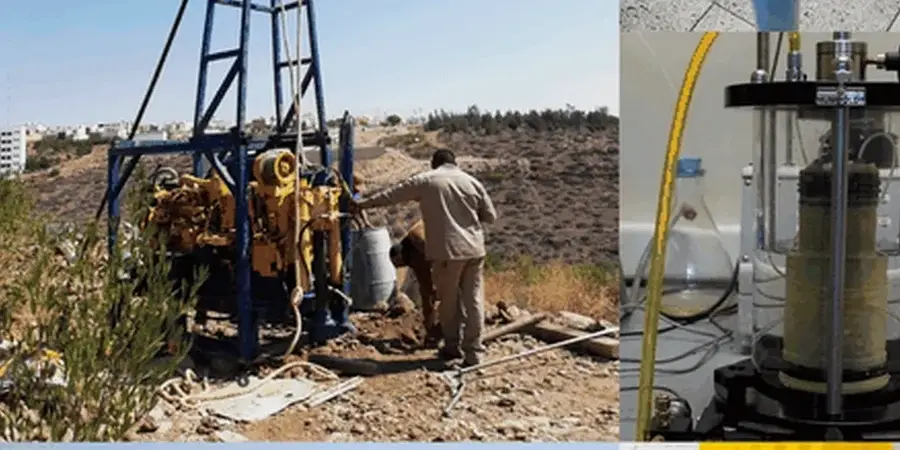
A warehouse expansion near the North Canadian River stalled for three months when the geotech discovered loose alluvial sands at 18 feet — classic liquefiable material in a region that underestimates its seismic exposure. Oklahoma City sits on Permian-age red-bed shales and Quaternary river deposits, and while the 5.7 magnitude Prague quake of 2011 is a fading memory, the deeper Meers Fault in the Wichita Mountains remains active enough to warrant a serious soil liquefaction analysis for any structure classified above Risk Category II. Our team correlates standard penetration resistance from SPT drilling with fines content and groundwater depth to compute the factor of safety against cyclic softening, delivering a report that satisfies the city’s building official and the structural engineer on the first submittal. When the geotechnical baseline demands higher resolution, we deploy CPT testing to map pore pressure dissipation and capture thin silt seams that a split-spoon sampler misses.

Liquefaction doesn't require a California-size earthquake — a magnitude 5.5 event within 50 miles can trigger cyclic softening in saturated sands, and Oklahoma City has that seismic source.
Our service areas

Process and scope

The most expensive mistake we see in Oklahoma City is a geotechnical report that stops at bearing capacity and neglects the liquefaction triggering analysis altogether — then the structural engineer designs a mat foundation, and six weeks later the plan reviewer sends it back with a redlined request for a site-specific seismic hazard study. A proper soil liquefaction analysis must integrate the updated USGS ground motion maps with field data that captures the soil’s state parameter, not just blow counts. We run cyclic stress ratio calculations per the simplified procedure, cross-checked with laboratory cyclic triaxial tests on undisturbed samples when the project budget and schedule allow. For sites east of I-35 where the water table can rise within 8 feet of grade during spring storms, the post-liquefaction settlement estimate often controls the foundation decision more than the static settlement ever would. The deliverable includes liquefaction potential index maps, residual strength profiles, and a clear recommendation on whether ground improvement — like stone columns or deep soil mixing — is needed before construction starts.
Soil Liquefaction Analysis in Oklahoma City
Technical reference — Oklahoma City

Local geotechnical context

Oklahoma City’s seismic hazard is deceptive because the deep earthquake clusters along the Nemaha Ridge and the occasional felt events from the New Madrid Seismic Zone produce long-period ground motions that travel efficiently through the sedimentary basin. A magnitude 6.0 event 200 miles away can generate peak ground accelerations of 0.10g to 0.15g at the surface — enough to trigger liquefaction in the saturated fine sands that underlie the North Canadian and Oklahoma River corridors if the duration exceeds 15 to 20 seconds. The red-bed claystone bedrock is competent, but the overlying Quaternary fluvial deposits can be as loose as 30% relative density, and without a soil liquefaction analysis, the structural engineer has no basis to estimate differential settlement under seismic loading. The IBC classifies much of Oklahoma County as Seismic Design Category C, which means Risk Category III and IV structures must have a site-specific study, not a default screening.

Need a geotechnical assessment?

Reply within 24h.

Email: contact@geotechnical-engineering.xyz

Applicable standards

ASCE 7-22 Minimum Design Loads and Associated Criteria for Buildings and Other Structures, IBC 2021 Section 1803 Geotechnical Investigations, ASTM D1586 Standard Test Method for Standard Penetration Test (SPT) and Split-Barrel Sampling of Soils, ASTM D2487 Standard Practice for Classification of Soils for Engineering Purposes (Unified Soil Classification System), ASTM D5311 Standard Test Method for Load Controlled Cyclic Triaxial Strength of Soil

Technical parameters

ParameterTypical value
MethodologySimplified procedure (Seed & Idriss) with CPT and SPT correlation per Robertson & Wride
Seismic demandUSGS 2023 NSHM PGA and spectral accelerations for 2% probability of exceedance in 50 years
Depth of investigationUp to 60 ft below grade, extended to 100 ft for projects near the Deep Fork River floodplain
Parameters computedCSR, CRR, FS against liquefaction, LPI, LSN, post-liquefaction settlement
Groundwater correctionSeasonal high water table from site piezometers, plus 3 ft conservative offset per IBC 1803.5.4
Report standardASCE 7-22 Chapter 11 and IBC 2021 Section 1803, with peer review by a P.E. geotechnical engineer
Lab testing optionCyclic triaxial (ASTM D5311) on undisturbed Shelby tube samples from target liquefiable layers

Common questions

Does Oklahoma City really have enough seismic risk to require a liquefaction analysis?

Yes, particularly for sites near the North Canadian and Oklahoma Rivers where saturated loose sands are common. The IBC 2021 classifies much of Oklahoma County as Seismic Design Category C, and the USGS hazard maps show a 2% in 50-year PGA exceeding 0.15g in parts of the metro area. Structures in Risk Category III (schools, assembly occupancies) and IV (hospitals, emergency response facilities) must have a site-specific liquefaction evaluation per ASCE 7-22 Chapter 11.

What is the cost range for a soil liquefaction analysis in Oklahoma City?

A complete soil liquefaction analysis in Oklahoma City, including field exploration and the engineering report, typically ranges from US$2,220 to US$4,100 depending on the depth to groundwater, the number of borings or CPT soundings required, and whether laboratory cyclic triaxial testing is included.

How deep do you investigate for a liquefaction study here?

We typically investigate to 60 feet below existing grade, which covers the depth where most liquefaction occurs. For critical structures or sites near the Deep Fork River floodplain where deeper alluvial deposits exist, we extend the borings and CPT soundings to 80 or 100 feet to capture the full liquefiable profile.

Can you use existing geotechnical data from our site, or do you need new field work?

We can incorporate existing SPT data if the borings are recent and the energy calibration (N60) and fines content are documented. However, most existing reports in Oklahoma City were produced before the current USGS hazard model and may lack the groundwater measurements needed for a reliable liquefaction triggering analysis, so we often recommend at least one supplementary CPT sounding to verify the stratigraphy and pore pressure conditions.

Location and service area

We serve projects in Oklahoma City and surrounding areas.

View larger map