GEOTECHNICAL ENGINEERING
OKLAHOMA CITY
HomeInvestigationCPT (Cone Penetration Test)

CPT Testing in Oklahoma City: Accurate Cone Penetration Data

Evidence-based design. Reliable delivery.

LEARN MORE

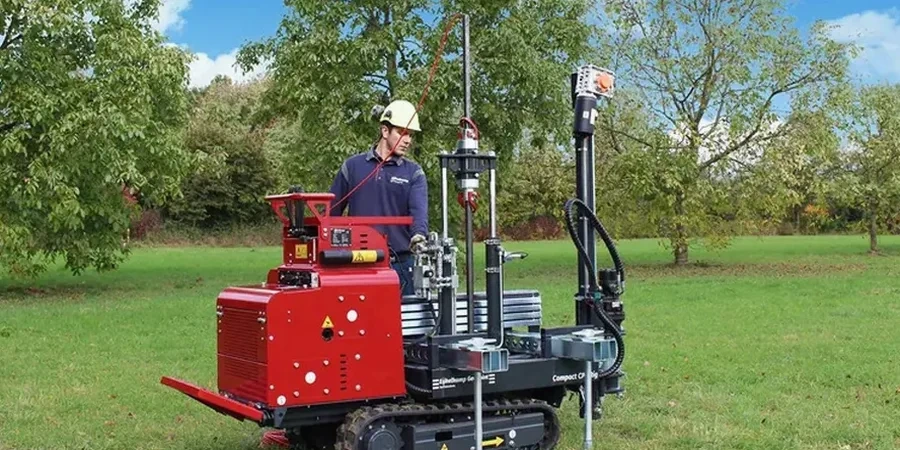
Oklahoma City sits on a complex quilt of Permian red beds and Quaternary alluvium, which makes foundation design anything but straightforward around here. The International Building Code (IBC) requires a thorough geotechnical investigation, and when you need continuous stratigraphic profiles without the disturbance of traditional drilling, the cone penetration test is the tool that delivers. Our lab runs a calibrated electric friction-cone rig that pushes through the stiff clays and sandy lenses common in the Oklahoma River basin, logging tip resistance, sleeve friction, and pore pressure in real time. For projects near the North Canadian River where soft channel deposits hide under fill, we often pair CPT soundings with test pits to visually confirm the transition zones the cone detects. That combination saves our clients from surprises during excavation.

A CPT profile gives you a signature of the soil column every centimeter—no gaps, no guesswork between samples.
Our service areas

Process and scope

Oklahoma City’s population passed the 700,000 mark a few years back, and that growth is pushing construction into areas where the soil profile can change within a hundred feet. The CPT gives us a near-continuous reading of what is happening underground—something you simply do not get with split-spoon sampling alone. We log corrected cone resistance (qt) and friction ratio (Rf) every centimeter, then run the data through soil behavior type charts based on Robertson’s 1990 classification, which holds up well for our local red-brown silty clays and the occasional cemented sandstone stringers. On commercial sites where shallow footings are borderline, the CPT data feeds directly into bearing capacity calculations, and we often recommend supplementing the profile with grain size analysis on thin sand seams the cone picks up—those seams control drainage and can make or break a footing design. For deeper projects near downtown where bedrock refusal is a concern, we combine the CPT data with seismic refraction to map the top of the Garber Sandstone without excessive drilling.
CPT Testing in Oklahoma City: Accurate Cone Penetration Data
Technical reference — Oklahoma City

Local geotechnical context

The biggest geotechnical headache in Oklahoma City is not just the expansive clay—it is the variability. We have seen sites on the east side where a stiff lean clay at 8 feet gives way to a loose silty sand lens that nobody knew was there. A standard boring with SPT every 5 feet can miss that lens entirely. The CPT catches it. If that sand lens is saturated and the site is in Seismic Site Class D or E, you suddenly have a liquefaction risk that the structural engineer did not plan for. The 2011 Prague earthquake sequence, though centered 50 miles east, was felt strongly here and reminded everyone that Oklahoma is no longer seismically quiet. Ignoring thin saturated layers is how you end up with differential settlement that cracks slab-on-grade foundations within the first two years. The CPT gives us the resolution to flag those layers before the concrete is poured.

Need a geotechnical assessment?

Reply within 24h.

Email: contact@geotechnical-engineering.xyz

Applicable standards

ASTM D5778-20 (Standard Test Method for Electronic Friction Cone and Piezocone Penetration Testing of Soils), ASTM D2487 (Classification of Soils for Engineering Purposes — Unified Soil Classification System), IBC 2021 Section 1803 (Geotechnical Investigations), ASCE 7-22 Chapter 20 (Site Classification Procedure)

Technical parameters

ParameterTypical value
Maximum penetration depth60 ft (18.3 m) with standard rig
Cone tip area10 cm² standard electric cone
Measured parametersqc, fs, u2 pore pressure
Corrected outputqt, Rf, Bq, normalized SBTn
Data acquisition rate2 readings per cm
Sleeve friction range0 to 1 MPa standard, extended optional
Applicable standardASTM D5778-20

Common questions

What does a CPT test in Oklahoma City typically cost?

For a standard single-sounding CPT job within the Oklahoma City metro area, you are generally looking at US$180 to US$250 per sounding, depending on depth and whether we need to pre-drill through fill or pavement. Deeper profiles, dissipation tests, or multiple soundings on the same site can shift the per-unit cost. We provide a firm quote after reviewing the site location and target depth.

How deep can you push the cone in Oklahoma City soils?

It depends entirely on the subsurface. In the alluvial deposits along the Oklahoma River, we routinely reach 40 to 55 feet before hitting refusal on the Permian shale or sandstone. In areas with thick, stiff red clay, we may see refusal shallower—around 25 to 35 feet—when the cone tip encounters a cemented caliche layer or the top of the Garber Sandstone.

Can CPT replace soil borings for foundation design?

CPT provides continuous stratigraphic data and excellent estimates of soil strength and type, but it does not recover a physical sample. For most foundation designs in Oklahoma City, we recommend a hybrid approach: CPT for the detailed profile and a few targeted SPT borings to recover samples for index testing—Atterberg limits, grain size, and moisture content—so you have both continuous data and physical material to classify.

How long does a CPT test take on site?

A single sounding to 40 or 50 feet typically takes 45 minutes to an hour once the rig is set up. The setup and breakdown add another 30 to 45 minutes. For a standard two-sounding job, you should plan on our crew being on site for about half a day. We can often have the preliminary profile to you the next business day.

Does CPT work in Oklahoma City's expansive clays?

Yes, and it works well. The cone measures tip resistance and sleeve friction, which reflect the in-situ state of the clay—stiffness, stress history, and undrained shear strength. What CPT does not give you directly is the swell potential. For that, we still need a sample to run Atterberg limits and possibly a swell-consolidation test. We typically pair CPT with a few shallow test pits or thin-wall tube samples to cover the expansive soil evaluation the IBC requires.

Location and service area

We serve projects in Oklahoma City and surrounding areas. More info.

View larger map