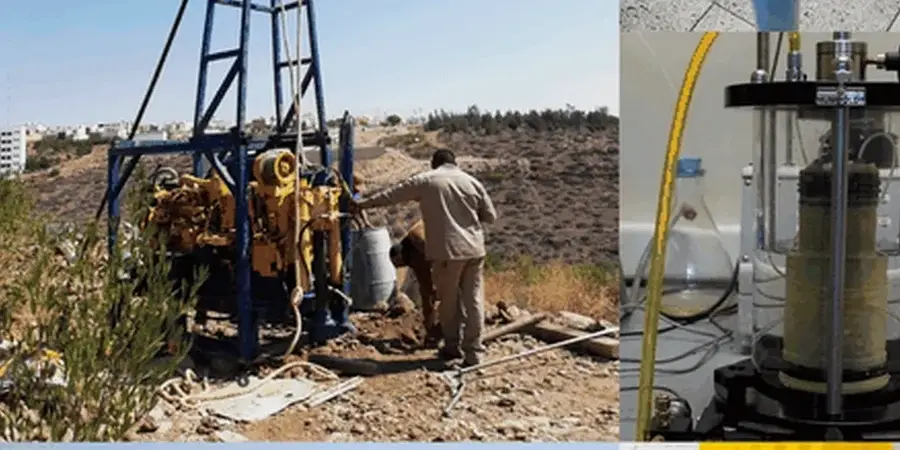
Oklahoma City sits at roughly 1,200 feet above sea level, and its 700-plus square miles of suburban and industrial development roll over a subgrade that makes rigid pavement design both a necessity and a recurring challenge here. The clay formations that dominate the metro area, from the Mustang series to the Kirkland silty clay loam, swell with spring moisture and shrink hard during the 100-degree July afternoons that define the Oklahoma summer. When a warehouse owner in the Will Rogers World Airport logistics corridor or a contractor laying out a new subdivision north of Lake Hefner plans a concrete parking lot, the slab doesn't just carry truck loads — it has to survive volume change cycles that can lift an unreinforced joint by half an inch. Our laboratory testing program for rigid pavement design in Oklahoma City starts with the subgrade, because in this city the soil is never a passive material. The concrete thickness, the dowel diameter, and the joint spacing all depend on what the base layer does when it gets wet, and we measure that directly through the Atterberg limits and the k-value of the prepared subgrade. For projects where the clay profile varies across the site, we often integrate findings from test pits to map the depth to bedrock or to locate the transition between the weathered shale and the overlying alluvium, which changes the modulus of subgrade reaction by a factor of two or more.
In Oklahoma City clay, a rigid pavement slab is only as reliable as the modulus of subgrade reaction you measure after the first wetting cycle.