GEOTECHNICAL ENGINEERING
OKLAHOMA CITY
HomeGeophysicsElectrical resistivity / VES (Vertical Electrical Sounding)

Electrical Resistivity Testing in Oklahoma City – VES Surveys for Subsurface Characterization

Evidence-based design. Reliable delivery.

LEARN MORE

Oklahoma City’s subsurface can flip in a single block. A site near the North Canadian River might show saturated sandy loam, while a lot up in Nichols Hills sits on dense red-bed claystone just a few feet down. That contrast is exactly why we rely on vertical electrical sounding here. The VES method helps us map these transitions without cutting a single trench. By reading resistivity contrasts, we get a clear picture of where competent rock begins and where troublesome clays might hold water. For deeper investigation, the data from a CPT test pairs well with resistivity profiles, especially when you need to confirm the mechanical properties of a layer that looks electrically soft. We have run these surveys from the industrial flats near Will Rogers Airport to the rolling terrain around Lake Hefner, and the local geology always keeps us honest.

The biggest risk we see in Oklahoma City is not bad soil. It is designers relying on a single boring and missing what sits five feet to the left.
Our service areas

Process and scope

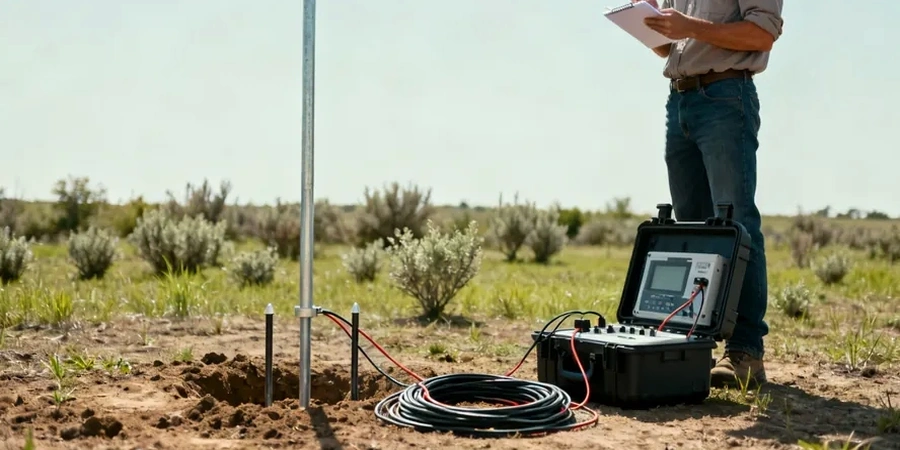
The mistake we see most often around the metro is assuming uniform soil conditions across a building footprint. A designer will spec a foundation based on one boring near the street, and then halfway through excavation they hit a perched water table in a sandstone lens that nobody predicted. Vertical electrical sounding catches these hidden layers. We pass current into the ground through four electrodes and measure how the subsurface resists flow. Clays, with their high cation-exchange capacity, read low resistivity. Dry sandstone or limestone reads high. The VES curve then gives us a layered model of apparent resistivity versus depth. In Oklahoma City, where the Garber-Wellington aquifer can influence shallow saturation, this data is critical. We calibrate our results against local boring logs and follow ASTM D6431 guidelines so the interpreted stratigraphy holds up under review. It is not a replacement for drilling, but it fills in the gaps between boreholes with a continuous profile that drilling budgets rarely allow.
Electrical Resistivity Testing in Oklahoma City – VES Surveys for Subsurface Characterization
Technical reference — Oklahoma City

Local geotechnical context

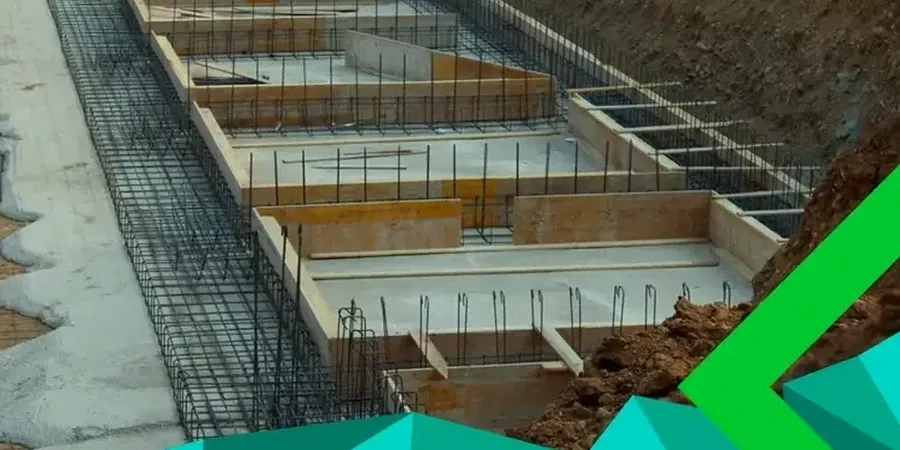
One thing any contractor working in central Oklahoma learns is that red clay can look dry on the surface and be fully saturated six inches down. We have walked sites near the Deep Fork River where the resistivity readings dropped sharply at ten feet, indicating a zone of saturation the owner had not anticipated. If you miss that, you are looking at excavation instability or a foundation design that does not account for the true bearing conditions. The other headache is differential settlement across mixed geology. A footing bearing partly on sandstone and partly on expansive clay will move unevenly over time. The VES survey gives us a cross-section that shows exactly where those transitions occur, so the engineer can adjust the foundation plan or specify a structural slab that bridges the variable ground. It is practical, local knowledge applied through geophysics.

Need a geotechnical assessment?

Reply within 24h.

Email: contact@geotechnical-engineering.xyz

Applicable standards

ASTM D6431-18 Standard Guide for Using the Direct Current Resistivity Method for Subsurface Site Characterization, IBC 2021 Section 1803 Geotechnical Investigations, ASCE 7-22 Minimum Design Loads for Buildings and Other Structures

Technical parameters

ParameterTypical value
MethodSchlumberger array (vertical electrical sounding)
Target Depth Range3 to 120 feet below grade
Typical Electrode SpacingAB/2 from 1.5 m to 150 m depending on target
Soil ResolutionDetects layers thicker than 10–15% of depth
Primary Lithologies MappedRed-bed claystone, sandstone lenses, alluvial silts
Data OutputApparent resistivity curve, interpreted layer model
Applicable StandardASTM D6431-18

Common questions

What does a VES survey cost for a typical commercial lot in Oklahoma City?

For a standard commercial lot with a few sounding points, budgets generally run between US$610 and US$1.180 depending on target depth and access conditions. We can give a firm number once we see the site layout.

How deep can resistivity testing see in Oklahoma City soils?

With the Schlumberger array we typically investigate down to about 120 feet. In practice, most OKC projects need high resolution in the top 40 feet where the red-bed claystone and alluvial layers control foundation design.

Does wet weather affect the readings?

Yes, and we plan around it. Saturated ground lowers resistivity and can mask layer contrasts. We prefer to run surveys during drier periods, and we always note recent rainfall in the report so the engineer can interpret the data with full context.

Location and service area

We serve projects in Oklahoma City and surrounding areas.

View larger map