GEOTECHNICAL ENGINEERING
OKLAHOMA CITY
HomeSeismicBase isolation seismic design

Base Isolation Seismic Design in Oklahoma City — Protecting Critical Structures

Evidence-based design. Reliable delivery.

LEARN MORE

Oklahoma City doesn't get the headlines that California does, but anyone working in design here knows the seismic reality changed after 2011. The induced seismicity from deep injection wells, combined with natural faults like the Meers Fault, means engineers now deal with a completely different risk profile. The red clay soils common across the metro — expansive, moisture-sensitive, and highly variable — complicate things further. When you place a critical facility on ground that amplifies short-period motion, standard fixed-base design stops being enough. Base isolation decouples the structure from that ground motion, and that's where our team steps in. We don't just run software — we understand the Oklahoma Geological Survey's updated hazard maps and how ASCE 7-22 applies to the specific site class you're building on. For projects where downtime after an event is unacceptable, we combine the isolation design with a seismic microzonation study to nail down site-specific spectra before the first isolator is even selected.

Base isolation in Oklahoma City is not about designing for 'the big one' — it's about controlling performance during the frequent moderate events that erode operational continuity.
Our service areas

Process and scope

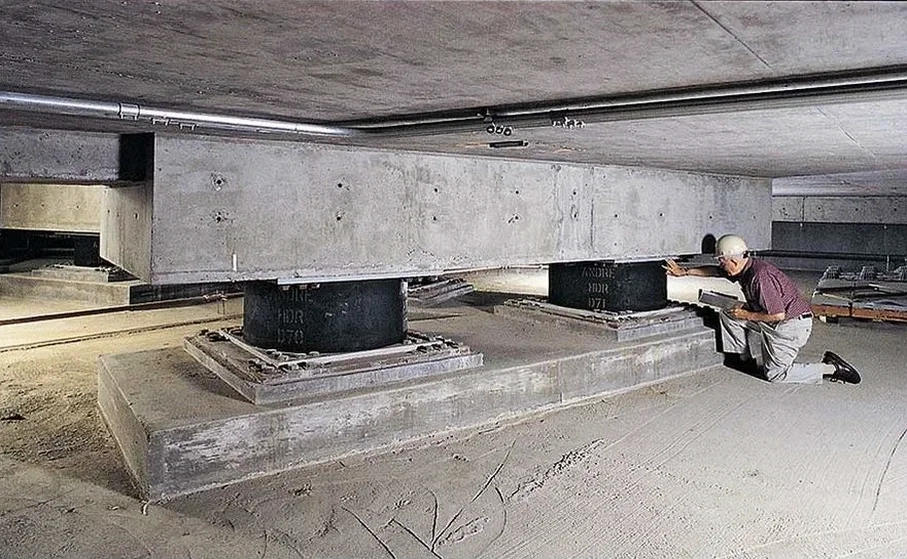
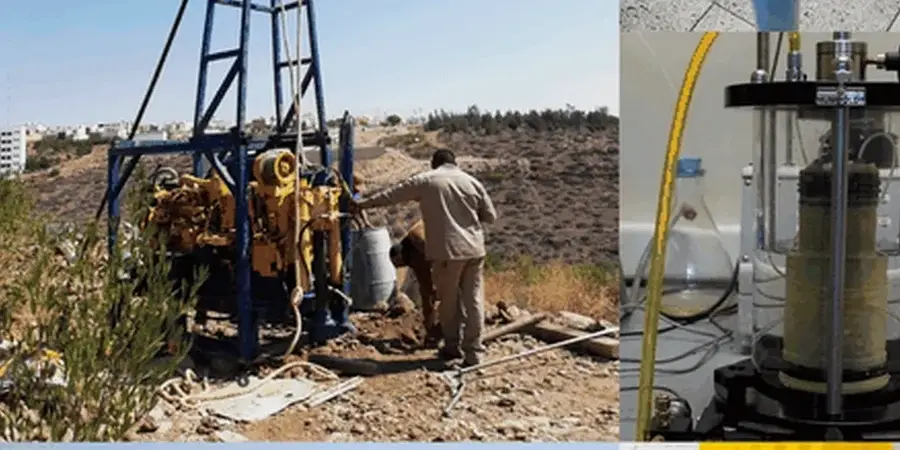
ASCE 7-22 Chapter 17 governs seismic isolation design in the U.S., and the IBC requires peer review for any structure using it. Oklahoma City sits in a tricky spot: most sites classify as Site Class C or D, with some river-adjacent areas near the North Canadian River dropping into Site Class E. Those softer profiles create a resonance risk for mid-rise buildings — exactly the kind of problem isolation solves. Our design process starts with characterizing the subsurface through in-situ permeability testing when we suspect high plasticity clays could affect long-term isolator performance, and we often pair that with a CPT test program to get continuous stratigraphy without disturbing the sample. The isolator selection — whether lead-rubber bearings, high-damping rubber, or friction pendulum systems — depends on the spectral acceleration at 1.0 second period, the building's fundamental period in the isolated condition, and the displacement capacity needed for the Maximum Considered Earthquake. We size wind restraint systems differently here too: the spring storms that roll across the plains impose lateral demands that California designers sometimes underestimate. Our submittal packages include nonlinear time-history analysis, stability checks for the isolation interface, and detailing for the moat wall that accounts for the full 3D displacement orbit. Every calculation ties back to a specific subsection of ASCE 7, and our peer reviewers appreciate that traceability.
Base Isolation Seismic Design in Oklahoma City — Protecting Critical Structures
Technical reference — Oklahoma City

Local geotechnical context

Take two sites across town from each other. The medical district near OU Health Sciences Center sits on relatively stiff, overconsolidated clays — Site Class C, maybe D in some pockets. Push west toward the alluvial deposits along the Oklahoma River, and you hit softer silts and sands that can drop into Site Class E. A fixed-base hospital on the first site might ride out a magnitude 5.0 event with minor cracking. The same design on the second site could see amplified spectral accelerations that push nonstructural components past their drift limits. That's the difference base isolation makes. By shifting the fundamental period out of the high-energy range — typically above 2.5 seconds — the superstructure moves essentially as a rigid body. Floor accelerations drop, drift concentrates at the isolation plane, and the contents stay put. When you're protecting surgical suites, server farms, or emergency operations centers, that performance gap matters. We learned from the Prague sequence in 2011 that the cumulative effect matters too: multiple moderate events can degrade fixed-base connections over time. Isolation handles cumulative demand differently, and that's why Oklahoma City's essential facility owners are increasingly asking for it at the schematic design phase.

Need a geotechnical assessment?

Reply within 24h.

Email: contact@geotechnical-engineering.xyz

Applicable standards

ASCE/SEI 7-22 Minimum Design Loads and Associated Criteria for Buildings and Other Structures, IBC 2021 (International Building Code) §1705.13 — Seismic Isolation, ASCE/SEI 41-23 Seismic Evaluation and Retrofit of Existing Buildings, ASTM D2487 — Unified Soil Classification System (subsurface characterization for site class), FEMA P-695 Quantification of Building Seismic Performance Factors

Technical parameters

ParameterTypical value
Target isolated period2.5–3.5 s (typical for mid-rise on Site Class C/D)
Design displacement (DBE)8–18 in. depending on MCE spectral demand
Effective damping ratio15–30% (HDR or LRB systems)
Moat wall clearance1.2 × total maximum displacement vector
Uplift restraint capacityPer ASCE 7 §17.2.4.3, verified by NLTHA
Peer review requirementsIBC §1705.13 — independent third-party review
Applicable site classesC, D, E per ASCE 7 Chapter 20
Wind restraint designFactored OKC wind loads per ASCE 7 Chapter 26

Common questions

What does base isolation seismic design cost for a project in Oklahoma City?

For a mid-rise building in Oklahoma City, the design package — from feasibility through peer-reviewed construction documents — typically runs between US$4,710 and US$8,870 depending on the complexity of the isolator system and the number of ground motion pairs required for time-history analysis. This covers the engineering deliverables; isolator hardware and testing are separate procurement items.

Does Oklahoma City require peer review for base-isolated buildings?

Yes. IBC §1705.13 mandates independent third-party peer review for any structure that uses seismic isolation. The reviewer must be approved by the building official and cannot be part of the design team. We prepare the submittal package with the reviewer's checklist in mind from day one, which saves time during permitting.

Which type of isolator works best for Oklahoma soil conditions?

It depends on the site class and the building's mass distribution. On Site Class C and D profiles common across Oklahoma City, both lead-rubber bearings and friction pendulum systems perform well. For softer Site Class E sites near the river corridors, we tend to favor high-damping rubber bearings because they handle the larger displacement demands without losing recentering capability. The decision comes out of the preliminary analysis, not a catalog pick.

How does induced seismicity affect the design parameters?

Induced events in Oklahoma tend to be shallow — often 3 to 8 km depth — and have different spectral content than tectonic earthquakes. The USGS and Oklahoma Geological Survey hazard models account for this, and we use the updated maximum considered earthquake spectra directly. The short-period acceleration can be higher than what an older map would suggest, which pushes the design toward a longer isolated period to keep floor accelerations within operational limits.

Location and service area

We serve projects in Oklahoma City and surrounding areas.

View larger map